
How Torticollis Can Affect Milestones - and What You Can Do About It


If you’ve ever been told your baby has a head turn preference but not to worry because “they’ll grow out of it,” this post is for you.
Yes, torticollis involves the neck - but its effects don’t stop there.
Torticollis can influence how your baby moves, how their body builds strength and coordination, and even how they reach major milestones like rolling, sitting, and crawling.
The good news? When we identify and address it early, babies do so much better.
Let’s unpack this in a way that actually makes sense - and that reassures that gut feeling you might have that maybe this isn’t something you should just “wait and see.”
What is Torticollis?
Torticollis sounds complicated, but it simply means a tightening of the neck muscles (usually the sternocleidomastoid muscle) that causes a baby to prefer turning their head in one direction. This can lead to a tilted head posture or even a flat spot from lying in the same position too often.
Signs of torticollis can include:
• Head consistently turned to one side
• Preference for feeding on one breast or side
• Flattening on one side of the head (plagiocephaly)
• Trouble turning their head both ways equally

How Torticollis Can Impact Milestones
Babies learn movement by exploring their bodies in all directions. When one side feels tighter or harder to move, they naturally avoid it. Over time, that avoidance can limit the variety of movement experiences they get - and those experiences are what build the foundation for rolling, sitting, and crawling.
Now let’s look at how this can show up in individual milestones.
Rolling
Rolling requires strength and symmetry on BOTH sides of the body.
If your baby prefers one direction or avoids turning their head to one side, they may:
Roll easily one way but not the other
Get stuck or give up before completing the roll
Not attempt rolling at all
That’s not due to a lack of effort, it’s a movement pattern that needs some support.
Sitting

Good sitting posture comes from a strong, balanced trunk
With torticollis, babies often:
Lean to one side
Use one arm more than the other to prop themselves
Slump or collapse while attempting to sit.
This can make sitting feel harder, which can delay confidence and progression in sitting skills.
Crawling & Pre-Crawling Movement
Before crawling, babies need to learn to shift their weight, coordinate their little limbs, and explore movement in multiple directions.
Neck tightness can interfere with:
Weight shifting evenly between sides
Looking where they want to go
Coordinating arm and leg movement together
If your baby is moving only in one direction or seems stuck in patterns like army crawl or scooting, torticollis could be part of the reason.
What You Can Do at Home (Right Now)
While you’re waiting for an appointment or thinking through next steps there are tons of ways to help support your baby right at home.

✅ Encourage tummy time when awake and alert - Tummy time is the number one way to help your baby's neck strength! the strong they are, the easier it will be for them to turn their head in either direction.
✅ Offer toys on both sides so your baby turns both ways - You can engage your baby's visual tracking and head movement in any position (back play, supported sitting, during tummy time)
✅ Limit time in containers (swings, rockers, car seats) so they have a chance to move freely on the floor throughout the majority of the day.
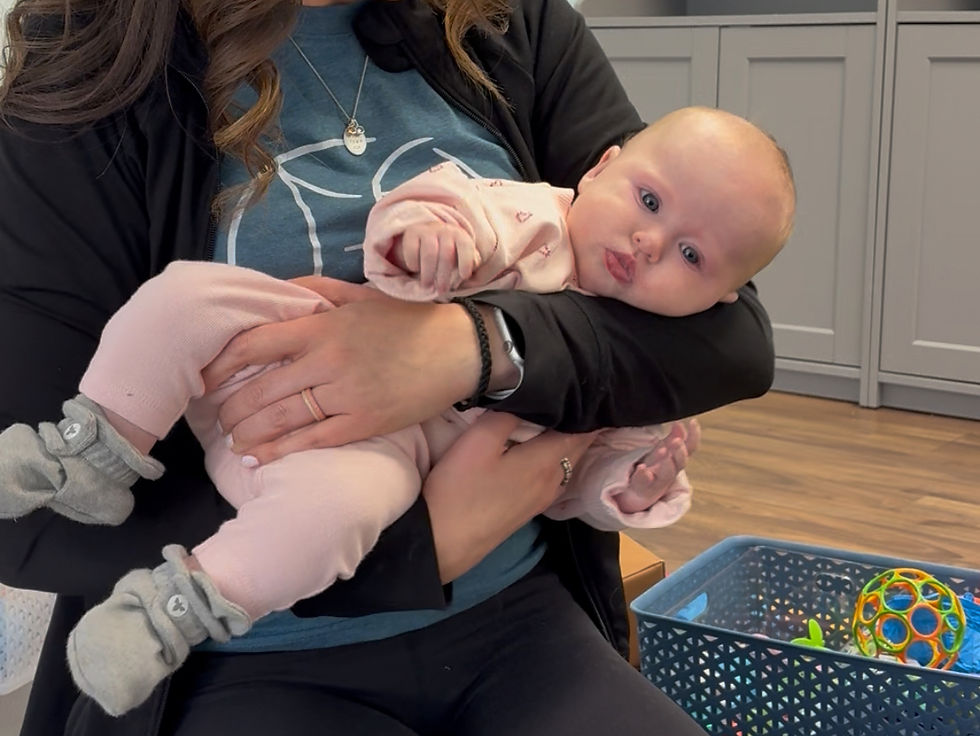
✅ Alternate hold and carry positions - Change up what side you hold baby on, or try this football hold (on the opposite side of the head turn preference) to encourage a more neutral head position!
A Quick Look at What the Evidence Says
It’s not just clinical experience that supports early attention to torticollis - the American Physical Therapy Association (APTA) has evidence-based clinical practice guidelines for the management of congenital muscular torticollis (CMT).
These guidelines emphasize that early screening for asymmetries in newborns - ideally within the first few days of life - and helps clinicians catch torticollis and other positional preferences before they become harder to change. The guideline encourages all providers who care for newborns (pediatricians, nurses, midwives, therapists) to check for restricted head turning, unequal neck motion, and positional flattening, and to refer for PT when needed.
This early attention matters, because the sooner movement patterns are addressed, the more easily babies learn full, symmetrical movement - including those big motor skills we all watch for.
You can read more about the APTA guideline and recommendations for torticollis here .
What Pediatric Physical Therapy Focuses On
Physical therapy for torticollis isn’t just stretching the neck muscles. A good PT will help you and your baby with:
Improving neck and full body range of motion in both directions
Supporting symmetrical posture and movement
Encouraging rolling, sitting, and reaching in balanced ways
Guiding positioning, play, and daily routines that reinforce movement patterns
We look at the whole baby - not just the head.
Wrapping It Up - What This Means for Your Baby
Torticollis is common.
Milestone delays are common.
And very often, the two are connected - not because something is wrong, but because movement patterns influence movement outcomes.
If you’ve noticed a strong head preference, uneven movement, or difficulty with rolling/sitting, it’s worth exploring.
Early screening and early intervention, like what the APTA guidelines support, gives your baby the best chance to move with confidence and ease.
You don’t have to “wait and see.” You can take steps today to help your baby thrive tomorrow.
Still feel like you need some help? Let's connect!


Comments